Search "how much fiber do you need for constipation" and you'll find answers ranging from 20 grams to 40 grams to "just eat more vegetables" — none of which explains why the number moves around so much, or what to do if more fiber isn't actually helping you. Below is what the intake guidelines actually say, what the clinical research on fiber and constipation shows (including the trials that complicate the "more fiber is always better" story), and a practical way to get there without spending a week bloated.
This post contains affiliate links. If you buy through one, we may earn a small commission at no extra cost to you. That relationship never changes what we recommend or how we describe the evidence — see our full affiliate disclosure.
The Baseline Number: What Health Authorities Recommend
The Dietary Reference Intake set by the Institute of Medicine, and still used by the NIH Office of Dietary Supplements, puts adequate daily fiber intake at roughly 25 grams for women and 38 grams for men under 50, dropping slightly to 21 grams and 30 grams after 50. That's a general nutrition target, not a constipation-specific dose — but it's the floor most people are working from, and most Americans land closer to 15 grams a day, which is part of why constipation is so common in the first place.
Does Constipation Need a Different (Higher) Number?
Clinical trials on fiber and constipation don't test the RDI number — they test therapeutic doses, which tend to run higher. A meta-analysis in World Journal of Gastroenterology pooled multiple randomized trials and found that fiber supplementation, generally in the 20-to-35-gram range per day, increased stool frequency and softened stool consistency compared with placebo (Yang et al., 2012). Most protocols in these trials didn't jump straight to that number — they built up over 2 to 4 weeks, which matters more than people expect (more on that below).
The Part Most Fiber Content Skips: More Isn't Always Better
Here's where the popular advice oversimplifies things. A study published in the same journal followed patients with chronic idiopathic constipation and slow colonic transit, and found that a subset of them actually improved when they reduced their fiber intake rather than increased it (Ho et al., 2012). Their constipation wasn't caused by too little fiber — it was a motility issue that more bulk made worse, not better.
That doesn't mean fiber is the wrong first move. For the average person with occasional or mild constipation, it's still the best-supported, lowest-risk starting point. But if you've already pushed your fiber intake well past 25–30 grams a day and you're more bloated and backed up, not less, that's a signal to stop increasing and talk to a doctor about ruling out a motility disorder — not a sign you need to eat more bran.
Not All Fiber Behaves the Same Way
The type of fiber matters as much as the amount. Soluble, gel-forming fiber — psyllium husk being the most studied — has more consistent evidence for relieving constipation across different subtypes than insoluble fiber (wheat bran, vegetable skins), which can make bloating worse in people with IBS-C. A review of the physiology behind this in the Journal of the Academy of Nutrition and Dietetics found that psyllium's gel-forming property helps it retain water through the colon and add stool bulk more predictably than other fiber sources (McRorie, 2017). That's part of why psyllium shows up as the fiber of choice in most constipation-specific clinical trials, rather than "eat more fiber" generically.
Getting There Without a Week of Bloating
The single most common way people undermine their own fiber increase is doing it too fast. A practical protocol that matches what the trials above used:
- Increase by about 5 grams a day, not all at once — give your gut a week to adjust before adding more
- Increase water intake alongside it — fiber needs fluid to do its job; without it, added fiber can make stool harder to pass, not easier
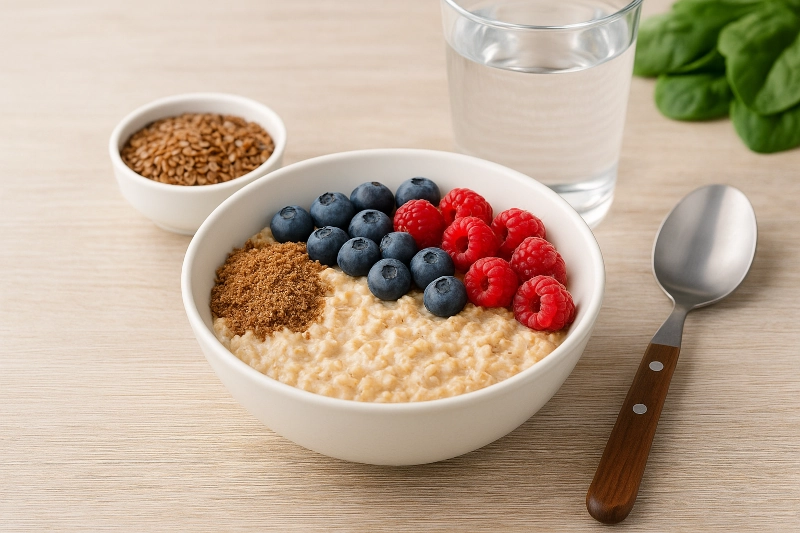
- Front-load soluble sources: oats, chia seeds, ground flaxseed, psyllium husk, pears, and cooked beans tend to be better tolerated than raw bran or a large salad dumped on day one
- Give it 2 to 4 weeks before judging whether it's working — most trials measured outcomes on that timeline, not after three days
When a Fiber Supplement Makes Sense
Food-first is still the better long-term habit — whole food fiber comes with water content, other nutrients, and a lower risk of overshooting. But closing a 15-to-25-gram daily gap through diet alone is a real behavior-change ask, and it's where a supplement earns its place for people who consistently fall short. GoldenFrib is one option built around a psyllium-based soluble fiber blend, packaged as a daily serving for people who don't want to track grams across every meal.
Whatever you choose — food, a psyllium supplement, or a mix — the dose that matters is the one you actually reach consistently. A theoretically perfect 35 grams a day that you hit twice a week does less than a steady 22 grams you hit every day.
Who Should Be Cautious With High Fiber Intake
- Anyone increasing intake suddenly — expect temporary gas, bloating, or cramping in the first 1–2 weeks; that's usually adjustment, not a reason to quit, but it should ease over time, not worsen
- People with a history of bowel obstruction, strictures, or recent GI surgery — added bulk can carry real risk here; talk to a doctor before increasing fiber rather than self-experimenting
- IBS-C patients — insoluble fiber in particular can worsen bloating; soluble fiber (psyllium) tends to be better tolerated, but should still be introduced gradually
- Anyone on thyroid medication, certain antidepressants, or specific antibiotics — fiber can affect how these are absorbed; a general rule is to space fiber supplements at least 2 hours from these medications, confirmed with a pharmacist
- Pregnant or breastfeeding readers — check with your OB before adding a new fiber supplement, even though fiber itself is generally considered low-risk
None of this replaces medical advice — see our medical disclaimer for the full context on how to read anything on this site.

The Bottom Line
For most adults dealing with occasional constipation, 25 to 35 grams of fiber a day — built up gradually, paired with more water, and weighted toward soluble sources like psyllium — is a reasonable, evidence-backed target. It doesn't work identically for everyone, and if pushing your intake higher is making things worse rather than better, that's real information, not a failure to try hard enough.
Check GoldenFrib's Current Price
FAQ
How much fiber do I need per day to stop being constipated?
Most clinical trials that show a benefit use doses between 20 and 35 grams a day, built up gradually over 2 to 4 weeks. The general nutrition baseline (25g for women, 38g for men under 50) is a reasonable starting target even if you're not sure of your exact constipation-specific number.
Can too much fiber make constipation worse?
Yes, for some people. Research on chronic idiopathic constipation with slow colonic transit found a subset of patients improved by reducing fiber, not increasing it. If you're well above 30 grams a day and getting more backed up, that's worth discussing with a doctor rather than adding more fiber.
How long does it take for fiber to relieve constipation?
Give it 2 to 4 weeks at a consistent intake before judging results — that's the timeline used in most of the studies showing a benefit. Judging after a few days is one of the most common reasons people give up too early.
Is psyllium husk better than regular fiber for constipation?
The evidence leans that way. Psyllium's gel-forming, soluble structure has more consistent support across different constipation subtypes than insoluble fiber sources like wheat bran, which can worsen bloating for some people, particularly those with IBS-C.
Should I drink more water when I increase fiber?
Yes — fiber needs fluid to move through the colon effectively. Adding fiber without adding water can make stool harder to pass, which is the opposite of the intended effect.
What's the fastest way to get more fiber without supplements?
Oats, chia seeds, ground flaxseed, pears, and cooked beans are well-tolerated, soluble-fiber-forward foods that are easier to add gradually than a large increase in raw vegetables or bran all at once.
References
- NIH Office of Dietary Supplements — Dietary Fiber Fact Sheet for Health Professionals
- Yang J, et al. (2012). "Effect of dietary fiber on constipation: a meta-analysis." World Journal of Gastroenterology. PubMed
- Ho KS, et al. (2012). "Stopping or reducing dietary fiber intake reduces constipation and its associated symptoms." World Journal of Gastroenterology. PubMed
- McRorie JW. (2017). "Understanding the Physics of Functional Fibers in the Gastrointestinal Tract." Journal of the Academy of Nutrition and Dietetics. PubMed