💰 Affiliate Disclosure: This post contains affiliate links. If you buy through them, we may earn a commission at no extra cost to you. We only recommend products we’ve researched and stand behind—this never changes our evaluation. See our full Affiliate Disclosure policy.
If you've spent any time looking at sleep supplements, you've probably seen the same three ingredients showing up together on label after label: magnesium, L-theanine, and GABA. It's a popular stack — but "popular" and "supported by evidence" aren't the same thing, and the three ingredients don't work the same way or have the same amount of research behind them. Here's what the actual studies say about each one, and where the combination holds up versus where it's mostly marketing logic.
Why This Combination Gets Marketed Together
The pitch behind stacking magnesium, L-theanine, and GABA is that each one nudges a different part of the nervous system's "off switch." Magnesium is involved in regulating the same inhibitory neurotransmitter system that GABA itself belongs to. L-theanine works on a separate pathway tied to alpha brain wave activity and stress reactivity. GABA supplements are added on the assumption that more of the neurotransmitter directly available means more inhibitory signaling. On paper, that's a reasonable theory of complementary mechanisms. In practice, one of these three ingredients has a well-documented problem getting to where it needs to work at all — more on that below.
Magnesium: The Best-Supported Piece of the Stack
Magnesium is a cofactor in over 300 enzymatic reactions, including ones that regulate the hypothalamic-pituitary-adrenal (HPA) axis — the system that governs your stress response — and NMDA receptor activity, which affects how easily the brain winds down. Low magnesium status has been associated with poorer sleep quality and higher markers of physiological stress.
The most-cited clinical trial here is a 2012 double-blind, placebo-controlled study in elderly adults with insomnia, published in the Journal of Research in Medical Sciences. Participants taking 500 mg of magnesium daily for eight weeks showed statistically significant improvements in sleep time, sleep efficiency, and early-morning awakening compared to placebo, along with lower serum cortisol (Abbasi et al., 2012). A separate systematic review in Nutrients found consistent (though not universally strong) evidence that magnesium supplementation reduces subjective anxiety and stress markers, which is relevant to sleep onset even outside a sleep-specific trial (Boyle et al., 2017).
Worth noting: most of the positive sleep trials used magnesium in older adults or people with documented insomnia, not healthy young sleepers. If you're not magnesium-deficient to begin with, the effect size is likely smaller than the study headlines suggest.
L-Theanine: Calm Without Sedation
L-theanine is an amino acid found naturally in green and black tea. Unlike magnesium or GABA, it doesn't work by directly triggering drowsiness — its main documented effect is increasing alpha brain wave activity, a pattern associated with a relaxed-but-alert state, while also blunting some markers of stress reactivity like heart rate response to a stressor.
A review in the Journal of the American College of Nutrition summarized theanine's effect as improving sleep quality primarily by reducing anxiety and mental arousal before bed, rather than by acting as a sedative itself — meaning it may help people who lie awake because their mind won't quiet down, more than people whose problem is staying asleep (Rao et al., 2015). That distinction matters: if your sleep issue is frequent night waking rather than a racing mind at bedtime, theanine alone is unlikely to be the fix.
L-theanine's safety profile across studies is good, and unlike some calming compounds it doesn't appear to cause next-day grogginess at standard doses (100–200 mg).
GABA: Where the Stack's Logic Gets Shaky
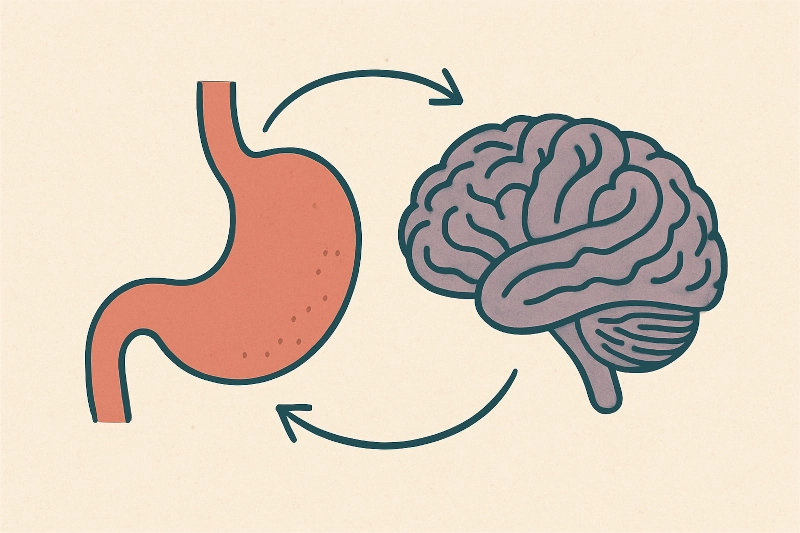
Gamma-aminobutyric acid (GABA) is the brain's primary inhibitory neurotransmitter — it's what calms neural firing down. The problem with oral GABA supplements is straightforward: GABA is a large, charged molecule, and under normal circumstances it does not cross the blood-brain barrier in meaningful amounts. Swallowing GABA doesn't put more GABA into your brain the way swallowing caffeine puts more caffeine into your brain.
Some human trials do report calming or relaxation effects from oral GABA, including a frequently cited 2006 study in Biofactors that found reduced stress markers and increased alpha wave activity after oral GABA administration (Abdou et al., 2006). But the proposed mechanism for those effects is debated — researchers have floated peripheral action on the enteric nervous system (GABA receptors exist in the gut) or effects mediated indirectly rather than GABA itself acting on brain receptors. In other words: some studies show an effect, but the field hasn't settled on why, and "it directly sedates your brain" is probably not the honest answer. Treat GABA as the weakest-evidenced ingredient of the three, not as the headline active ingredient the marketing often implies.
Does the Combination Actually Work Better Together?
Here's the honest answer: there isn't a large body of published research testing magnesium, L-theanine, and GABA specifically as a combined stack against each ingredient alone. Most of the evidence above comes from single-ingredient trials. The combination is a reasonable hypothesis built on complementary mechanisms — a mineral that supports inhibitory neurotransmission generally, an amino acid that reduces pre-sleep mental arousal, and a neurotransmitter with a debated but plausible calming effect — but it hasn't been validated as a stack the way, say, melatonin dosing has been.
That doesn't mean it's useless. It means you should treat claims about the specific combination with more skepticism than claims about magnesium or L-theanine individually, since those two have the more direct trial support.
Dosages Used in the Research
- Magnesium: Trials showing sleep benefits generally used 320–500 mg/day, often as magnesium glycinate or magnesium oxide, taken for several weeks before effects were measured — this is not a same-night result in most studies.
- L-theanine: Most sleep and relaxation research uses 100–200 mg, typically taken in the evening or roughly an hour before bed.
- GABA: Study doses cluster around 100–300 mg, though given the unresolved mechanism question above, dose-response data here is thinner than for the other two.
Combination products often use lower doses of each ingredient than the individual trials above, on the assumption the effects stack — a reasonable but unproven assumption. If you're evaluating a specific label, check the per-ingredient dose against the ranges above rather than trusting a proprietary blend total.
Speaking of proprietary blends — that's exactly the structure behind Pineal XT, one of the more heavily marketed products built around this topic. We fact-checked its claims in a separate review — short version, we'd skip it — but you're welcome to see the current offer on the official site and judge it yourself.
Who Should Be Cautious
This combination is not appropriate for everyone, and a physician conversation is warranted in several cases:
- Kidney disease or impaired kidney function: magnesium is cleared renally, and reduced kidney function raises the risk of magnesium accumulation and toxicity.
- Blood pressure medication or other antihypertensives: magnesium can have an additive blood-pressure-lowering effect.
- Other sedatives, benzodiazepines, or sleep medications: stacking multiple GABAergic-pathway compounds (prescription or otherwise) increases sedation risk in ways that haven't been well studied for this specific combination.
- Pregnant or breastfeeding individuals: none of these three ingredients have robust safety data in pregnancy at supplemental doses; check with an OB before starting.
- Anyone on diuretics or heart medication: magnesium interacts with several classes of these drugs.
Magnesium is also the one ingredient here with a well-documented, common side effect at higher doses: loose stools, especially with magnesium oxide or citrate forms. If that's an issue, magnesium glycinate is the form most often used in the sleep trials cited above and tends to be gentler on digestion.
The one product in this space we've actually run through our review process is Pineal XT — it didn't hold up (see our full breakdown above). As we vet more candidates, this post will link to specific recommendations rather than general ingredient guidance.
See Pineal XT's Current Offer →
FAQ
Is it safe to take magnesium, L-theanine, and GABA together every night?
For most healthy adults, short-term nightly use at standard doses appears reasonably well tolerated based on the individual-ingredient safety data, but there's no long-term trial specifically testing the combination taken nightly for months. Check with a doctor before making it a permanent routine, especially if you take other medications.
How long does it take to notice an effect?
L-theanine's calming effect on brain wave activity has been measured within about an hour of dosing. Magnesium's sleep benefits in trials were measured after several weeks of consistent use, not after a single dose — so don't judge magnesium by one night's results.
Does oral GABA actually reach the brain?
Under normal conditions, GABA does not meaningfully cross the blood-brain barrier, which is why its mechanism of action when taken orally is still debated among researchers. Some studies report calming effects anyway, possibly through peripheral or indirect pathways, but this is the least settled science of the three ingredients.
Can I take this stack instead of melatonin?
They work through different mechanisms — melatonin signals circadian timing, while this stack targets stress-related arousal and inhibitory neurotransmission. Some people use them together, but that's a separate stacking decision with its own considerations, not a direct substitution.
Which ingredient in the stack has the strongest evidence?
Magnesium has the most direct clinical trial support for sleep outcomes specifically, particularly in people with existing insomnia or lower magnesium status. L-theanine has solid support for reducing pre-sleep mental arousal. GABA has the weakest and most mechanistically uncertain evidence of the three.
What form of magnesium is best for sleep?
Magnesium glycinate is the form most commonly used in the sleep-specific trials and tends to cause less digestive upset than magnesium oxide or citrate, which are absorbed differently and more likely to have a laxative effect at higher doses.
References
- Abbasi B, Kimiagar M, Sadeghniiat K, et al. "The effect of magnesium supplementation on primary insomnia in elderly: A double-blind placebo-controlled clinical trial." Journal of Research in Medical Sciences, 2012. pubmed.ncbi.nlm.nih.gov/23853635
- Boyle NB, Lawton C, Dye L. "The Effects of Magnesium Supplementation on Subjective Anxiety and Stress: A Systematic Review." Nutrients, 2017. pubmed.ncbi.nlm.nih.gov/28387721
- Rao TP, Ozeki M, Juneja LR. "In Search of a Safe Natural Sleep Aid." Journal of the American College of Nutrition, 2015. pubmed.ncbi.nlm.nih.gov/26055828
- Abdou AM, Higashiguchi S, Horie K, et al. "Relaxation and immunity enhancement effects of gamma-aminobutyric acid (GABA) administration in humans." Biofactors, 2006. pubmed.ncbi.nlm.nih.gov/17190991